
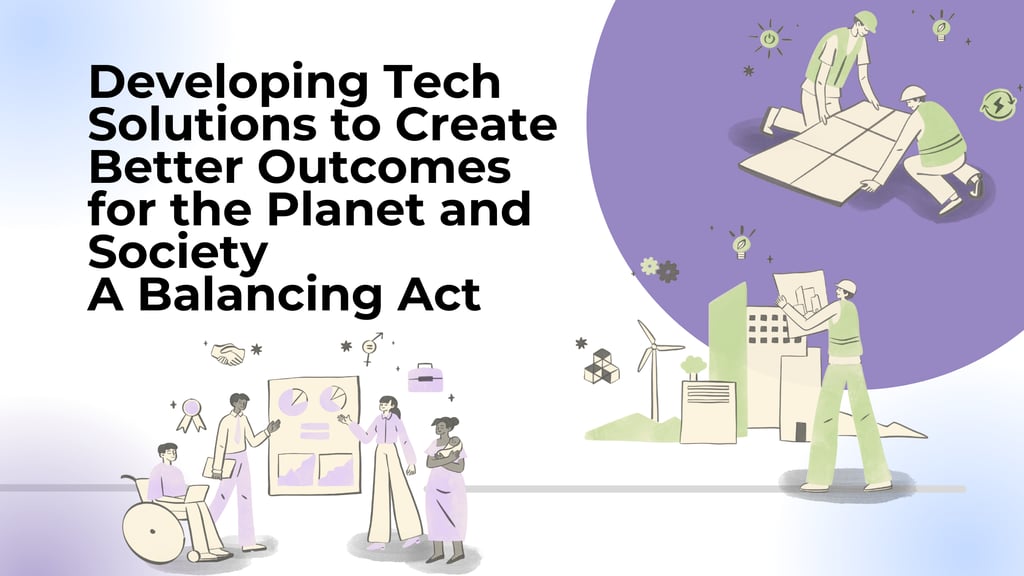
Developing Tech Solutions to Create Better Outcomes for the Planet and Society – A Balancing Act
Technology is obviously integral to addressing climate change, improving social impact, and I find the balancing act fascinating.
Ileana Lupsa
1/20/20262 min read
Technology is obviously integral to addressing climate change, improving social impact, and I find the balancing act fascinating. While you're building a solution to create a greener future, you also have to be mindful of its own footprint. Are you building a platform? Where and how are you hosting it? Where are you storing your data? How much water and energy are your operations consuming, and is that energy green? Are you building physical solutions, and what does your supply chain look like? It’s interesting that whilst you're trying to solve a problem, you might also be contributing to it.
And I absolutely love the breadth and depth of tech for good solutions out there:
Carbon removal and capture technologies – from direct air capture to carbon mineralisation
Renewable energy innovations – solar, wind, energy storage solutions, and green hydrogen
Sustainable agriculture and agritech – climate-smart farming, precision agriculture, and regenerative practices
Clean transportation – electrification and sustainable mobility solutions
AI and data analytics – for climate modeling, emissions monitoring, energy optimisation, and predictive analytics
Water stewardship – purification, desalination, and water management systems
Waste reduction and circular economy – from packaging innovation to bioremediation
Land and ocean restoration – reforestation, soil regeneration, and marine ecosystem recovery
Whilst we're driven to find innovative solutions across every sector and create cleaner, greener outcomes, we're simultaneously taking into consideration the impact we create by doing so.
So I think it's more important than ever to develop systems for regular knowledge sharing and continuous learning across ecosystems. Not only to see our immediate impact – whether positive or negative – but also to learn how others are addressing these challenges. Their innovative ways of working or thinking could unlock something for you. From my experience with cross-functional and cross-sector collaboration, I've seen how powerful this is. Having a different perspective, putting yourself in someone else's shoes to see what's important to them, brainstorming ideas and finding solutions together, realizing that something is replicable across other areas or regions – it's transformative.
Especially if you're a small mission-driven company developing these amazing technologies and solutions, if your impact feels limited, your ecosystem might be your goldmine. The network of suppliers, partners, and collaborators around you forms a web of support and innovation. Scaling impact starts with thinking beyond your organisation.
How to Turn Networks into Impact
Align with peers on a shared vision through clear communication and storytelling. When everyone understands not just what you're doing, but why it matters, collaboration becomes natural rather than forced.
Build practical infrastructure to connect with your ecosystem in meaningful ways. Create programs, events, and spaces that make collaboration easy and accessible, not just another item on someone's to-do list.
Measure what matters. Track collective outcomes, not just individual results. When you measure success as an ecosystem rather than as isolated organisations, you begin to see the real power of collaboration.
Orchestrate connections between strategy and delivery, between relationships and tangible change. It's about being intentional with how you bring people together and what you're working toward collectively.
Orchestrating work across ecosystems is not always easy, but it's surely impactful. And in a space where we're all working toward the same fundamental goal – a healthier planet and society – that collaborative approach isn't just beneficial, it's essential.