
When Everything Is A Priority: The Systems And The Mindset
What does it actually take to manage multiple workstreams running at the same time? Flawless systems and processes? Your mindset and attitude?
3/31/20264 min read
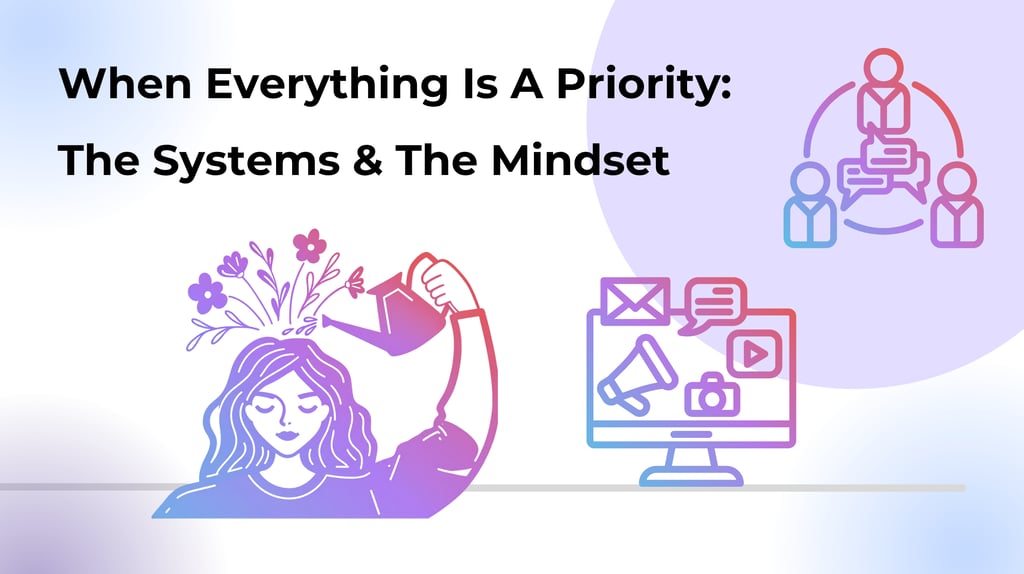
What does it actually take to manage multiple workstreams running at the same time? Flawless systems and processes? Your mindset and attitude? I think it’s a blend of both and worth acknowledging that as our work changes fast, so must our adaptability and creativity in how we approach it.
I recently completed a course on Leading with Motivational Intelligence and it gave me not only the opportunity for more in-depth self-reflection but also a framework to understand what's actually driving my behaviour, and to start doing something meaningful about it.
In this blog I am addressing the blend between the practical systems that help you manage your workload and your internal belief systems and mindset around how you approach challenges. I have been thinking about it in the context of having to manage multiple workstreams at the same time, because haven't you said or thought at least once in the last few weeks "everything is a priority!"
The practical side: building systems that work for you
Maybe you already implemented all or some of these, but I think it’s worth mentioning at least a few key ways which can really help make sense of the chaos.
A platform where you can keep track of your tasks and workstreams. Somewhere you can see the status, what is moving, what is stalled, and what needs your attention in the coming days. On a strategic level, connecting each of these back to your objectives helps you stay in alignment with the bigger vision. Setting priority levels and learning to distinguish between urgency and importance is a habit that pays off in the long run.
Communicating in a way that keeps everything transparent and honest across your teams and workstreams. Bringing everyone in on the journey and making sure the people are genuinely on the same page. The focus is on creating an environment where people feel included and nothing important gets lost between the gaps.
Stakeholder relationships focused on creating trust. Different stakeholders have different communication styles, priorities, and capacity. Taking the time to understand what each person actually needs from you, and showing up consistently in that way, builds the kind of trust that creates real working space when things get complicated.
Templates that save you time and create consistency. Seems obvious but is such an easy way to simplify your work because when you are managing multiple workstreams, you don’t need to reinvent the wheel for every status update, brief or check-in. Having a set of well-designed templates you can return to and adapt means you spend less time on the setup and more time on the work itself.
AI automations and workflows that keep things running smoothly. There are parts of delivery that are repetitive, time-consuming and do not actually need your full attention. Automating those where you can, but still keeping yourself in the loop for sign-off, can free you up to focus on the things that genuinely require your judgement and presence.
Making sure your data and inputs are of good quality. A system is only as reliable as the information going into it. If the data you are working from is incomplete, inconsistent or out of date, even the best tools and processes will struggle to give you a clear picture. Building good habits around how information is captured, updated and shared across your workstreams is one of those foundational things that makes everything else work better.
Having systems in place that work for you is great but is that enough? It can be but I think if you are looking to have a thoughtful approach that sustains you long term then implementing MQ practices can help.
The mindset side: where MQ comes in
Even with solid systems and processes in place, I found that it does pay off to take a closer look at your mindset and attitude when it comes to how you work and how you approach complexity and challenges. This is where I have recognised the importance of doing Motivational Intelligence work, and I have seen that applying it in practice takes more in-depth reflection than I anticipated.
At its core, MQ is about the ability to motivate yourself and others by identifying what is really driving your thoughts and beliefs, and building the clarity and confidence to move through obstacles rather than around them. I have always considered myself fairly self-aware, but the exercises made me look much more closely at my self-talk, my beliefs, and the mindset I bring to different situations.
What MQ gave me was a framework to understand what is actually driving my behaviour, and to start doing something meaningful about it. And I think this is particularly relevant when you are managing multiple workstreams at the same time, because that kind of complexity has a way of surfacing your underlying beliefs about your own capacity and judgement. When the pressure builds, those beliefs shape how you show up, often before you even realise it. You may start responding reactively rather than thoughtfully. It can become harder to distinguish what genuinely needs your full attention from what just feels that way.
For instance, something that stuck with me is every Friday afternoon thinking about your “high pay-off activities” as a way of identifying key activities that absolutely need doing for the following week and this not only sets you up to start the week with more clarity but also removes the stress and worry before you actually start the week.
As our mentor said during the course, belief recalibration and self-trust is where meaningful leadership growth happens. I think that is especially true in complex delivery, where you are constantly making judgement calls with incomplete information and maintaining your steadiness when things get uncertain. The outer system holds you up structurally, and the inner work is what determines how well you can actually use it.
Going through this will surface things that are specific to you, and that is really the value of it. Progress tends to come when you are willing to take actions that feel uncomfortable and to hold yourself genuinely accountable, not just for outcomes, but for the mindset you are bringing to the work itself. No matter where you are in your career or your delivery practice, I genuinely think that exploring MQ is valuable for both your personal and professional life.
So can you do one without the other? Sure, but I think it’s more useful to consider both aspects to create an environment that works for you and supports you.